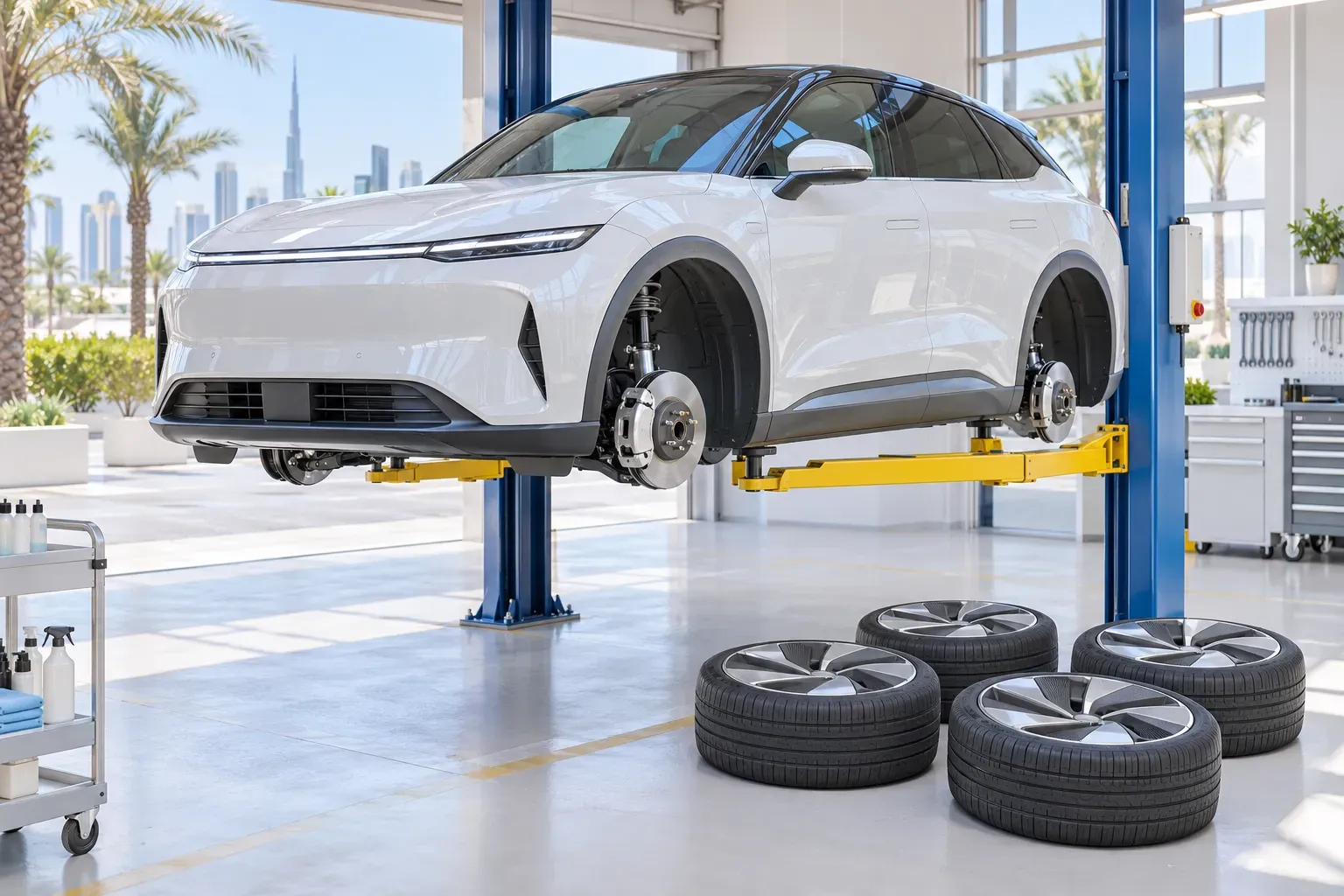
Why tyres wear unevenly
Each corner of the car does a different job. On a front-wheel-drive car, the front tyres steer, brake and drive, so they wear faster. On rear-drive cars and many single-motor EVs, the rear tyres take the drive force and can wear down first.
Rotating the tyres before the difference gets large spreads this wear across the set. All four then reach the end of their life at about the same time, and grip remains consistent front to rear.
Which rotation pattern is right?
Front-wheel-drive cars commonly use a forward cross, while rear-drive and all-wheel-drive cars commonly use a rearward cross or X-pattern. Your owner's manual will list the preferred pattern for your vehicle.
Directional tyres can only move front to back on the same side. Staggered setups, where the front and rear sizes differ, usually can only be swapped side to side if the tyre is non-directional, and sometimes cannot be rotated at all.
How often to rotate in the UAE
A common guide is every 8,000 to 10,000 km, which often fits neatly with your regular service. If you commute long distances between Sharjah and Dubai or Abu Dhabi, you may reach that sooner than you expect.
EVs and heavy SUVs can benefit from earlier checks. Measure the tread during each rotation, so you can catch wear patterns that point to alignment or pressure problems.
What rotation can reveal
Taking the wheels off gives a clear view of the inner tread, the brake discs and the suspension. Inner shoulder wear is easy to miss from outside and often only shows up when a wheel is removed.
If one tyre is wearing differently from the others, rotation alone will not solve it. Alignment, balancing or a worn suspension part may need attention first.
What is included
- Tread depth check on each tyre
- Rotation in the right pattern
- Wheel nut torque
- Pressure reset front and rear
- TPMS position relearn where required
How it works
- Measure tread. Each tyre's depth is recorded to see how it is wearing.
- Choose a pattern. The pattern depends on your drivetrain and tyre type.
- Swap positions. Wheels are moved and refitted to the correct torque.
- Set and relearn. Pressures are reset and sensors relearned if the car needs it.
What affects the final price
The figure above is a starting price, not a final quote.
- Car, SUV or EV
- Directional or staggered fitment
- TPMS relearn
- Balancing added
If you drive an EV
EV tyres often wear faster on the driven axle because of instant torque. Regular rotation helps, but staggered EV setups with different front and rear sizes limit what can be swapped.