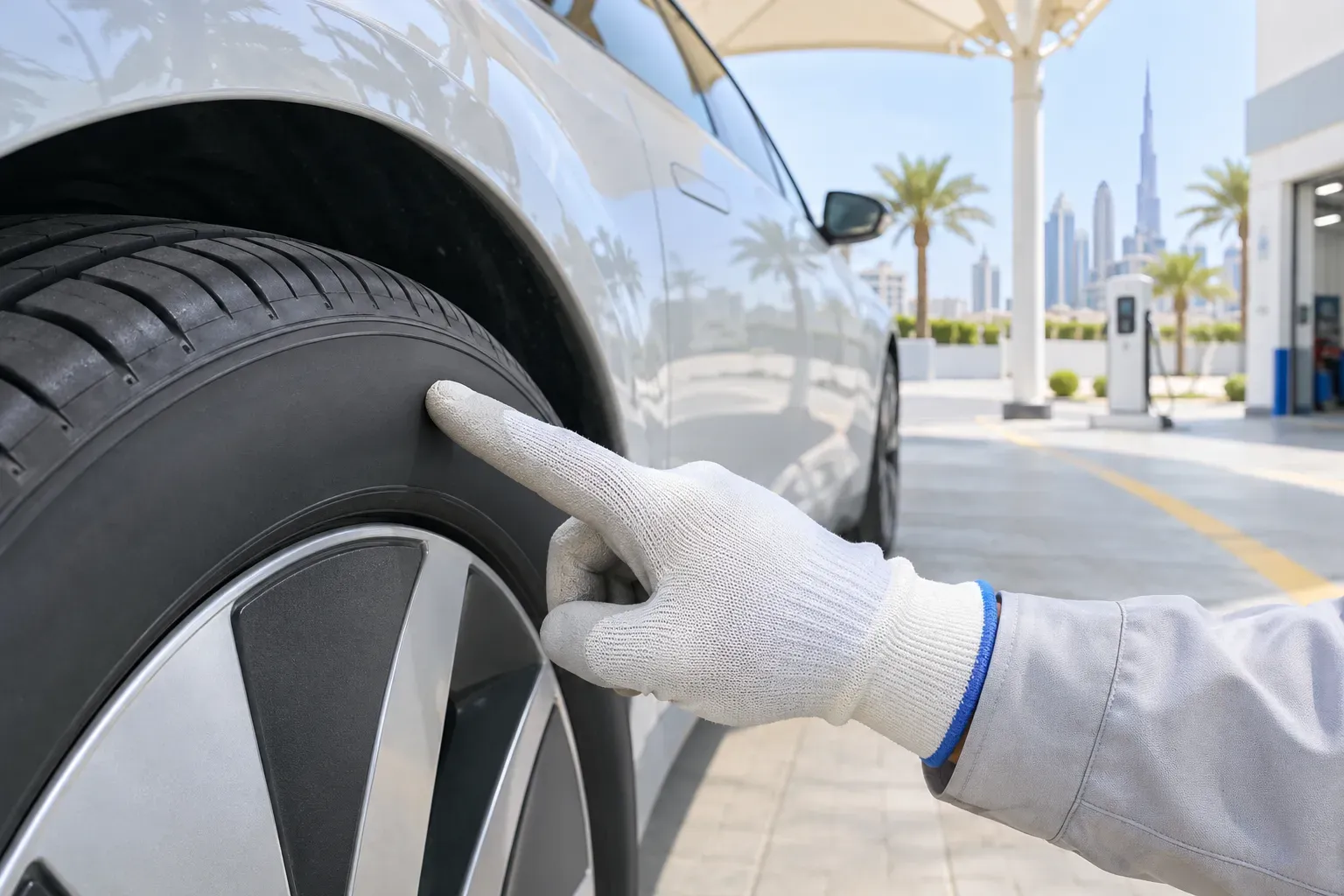
A tyre size such as 205/55 R16 91V means 205 mm wide, a sidewall height 55 percent of that width, radial construction, a 16-inch rim, load index 91 and speed rating V. Find it on your tyre sidewall or driver's door placard, and always match the load and speed ratings.
A tyre size such as 205/55 R16 91V tells you the tyre is 205 mm wide, its sidewall height is 55 percent of that width, it has radial construction, it fits a 16-inch rim, has a load index of 91 and a speed rating of V. You can find this code on the tyre itself or on the placard inside the driver’s door.
Once you can read it, you can check a quote, order the right tyre and spot a wrong fitment before it reaches your car. It only takes a few minutes to learn.
Where do you find your tyre size?
Check these three places, in this order:
- The driver’s door frame placard. This shows the size and pressures the manufacturer intended.
- The tyre sidewall. This shows what is currently on the car, which may not match the original if a previous owner changed it.
- The owner’s manual. It often lists every approved size for your trim.
If the placard and the tyre disagree, trust the placard or ask a technician before buying. You can also explore sizes visually on our tyre size guide.
What do the numbers mean?
Using 205/55 R16 91V as the example:
| Part | Example | Meaning |
|---|---|---|
| Width | 205 | Tyre width in millimetres |
| Aspect ratio | 55 | Sidewall height as a percentage of width |
| Construction | R | Radial |
| Rim diameter | 16 | Wheel diameter in inches |
| Load index | 91 | Maximum load per tyre, 615 kg |
| Speed rating | V | Maximum speed, 240 km/h |
Width
The first number is the width across the tyre in millimetres. A wider tyre puts more rubber on the road, but it can also add noise and rolling resistance.
Aspect ratio
The aspect ratio tells you the sidewall height. In our example, it is 55 percent of 205 mm, or about 113 mm. A lower number means a shorter sidewall, which sharpens the steering but makes the tyre more vulnerable to kerb impacts and potholes.
Construction
R means radial, and nearly every car tyre you will buy uses it. You may also see ZR on higher-speed tyres.
Rim diameter
This is the size of the wheel in inches. A tyre must match its rim exactly. A 16-inch tyre will not fit a 17-inch wheel.
Load index
The load index is a code for how much weight one tyre can carry at the proper pressure. It is not the weight itself, so use a chart:
| Load index | Max load per tyre |
|---|---|
| 91 | 615 kg |
| 94 | 670 kg |
| 98 | 750 kg |
| 100 | 800 kg |
| 105 | 925 kg |
| 110 | 1,060 kg |
Heavy cars need higher numbers. That matters for SUVs and for electric cars, which may also carry XL or HL markings. See do EVs need special tyres for why this matters.
Speed rating
The final letter is the maximum speed the tyre is designed to sustain under its rated load:
| Rating | Max speed |
|---|---|
| T | 190 km/h |
| H | 210 km/h |
| V | 240 km/h |
| W | 270 km/h |
| Y | 300 km/h |
Do not choose a lower rating than your car requires. You can learn how these numbers affect the way a car drives on our tyre performance page.
What other markings should you know?
The sidewall often includes other useful codes:
- XL or Reinforced: extra load capacity at higher pressure.
- HL: High Load, used on heavy cars such as many EVs.
- RFT, ROF, ZP or SSR: common signs of a run-flat tyre.
- M+S: mud and snow, seen on many all-season and all-terrain tyres.
- LT: light truck construction.
- DOT code: production details, including the manufacture date. See how to check tyre expiry date.
- TWI: tread wear indicator position.
- T0, T1, T2: Tesla-approved tyres. See my Tesla tyre guide.
- Max pressure: the tyre’s limit, which is not the pressure you should run. Use the door placard instead, as explained in my tyre pressure guide.
How do you work out the overall diameter?
If you are comparing two sizes, the overall diameter is the useful number. Here is the method for 205/55 R16:
- Sidewall height: 205 x 0.55 = 112.75 mm
- Two sidewalls: 112.75 x 2 = 225.5 mm
- Rim in millimetres: 16 x 25.4 = 406.4 mm
- Overall diameter: 225.5 + 406.4 = 631.9 mm
What is the 3 percent rule for tyres?
The 3 percent rule is a fitter’s guideline: if you are moving to a different size, keep the overall diameter within about 3 percent of the original. A bigger change can throw off the speedometer, cause rubbing and upset systems such as ABS and stability control.
It is only a guideline. Your manufacturer’s approved sizes come first, and you must keep at least the original load capacity and speed rating. That is especially true for EVs and all-wheel-drive cars.
Can you fit a different tyre size?
Yes, sometimes, but only within safe limits. People often upsize for looks, for instance by moving to a bigger rim with a lower profile. Before you do, ask:
- Is the new size approved for your car?
- Does it clear the arches and suspension at full steering lock?
- Is the load index at least equal to the original?
- Will the ride be too firm on UAE speed humps?
- Could it reduce an EV’s range?
If you are unsure, use our tyre size guide or send a photo of your sidewall and we can check it.
Common size mistakes I see
- Reading the size from an old tyre that was not the correct fitment.
- Forgetting that front and rear sizes can differ on staggered cars.
- Matching the size but ignoring the load index.
- Assuming every trim of a model uses the same wheel size.
- Ordering a tyre without checking its DOT date.
Do front and rear tyres have to be the same size?
Not always. Many sports cars, premium saloons and some EVs use a staggered setup, with wider tyres on the rear axle. The placard will show separate front and rear sizes when this applies. On these cars, you need to order the two sizes correctly and keep each on its intended axle.
Staggered tyres also change your maintenance plan. They usually cannot be rotated front to rear, so the driven axle may wear out sooner than the other one. Always read both sides of the car before ordering, because assuming all four tyres match is a common and costly error.
What to do once you know your size
With your size in hand, getting an accurate quote is simple. Check starting prices on our tyre price UAE page, read how much tyres cost in the UAE, or browse your make on our car brands section. When you are ready, book new tyres through our tyre shop in Dubai, or contact us from Abu Dhabi or Sharjah.