EV tyres often wear faster because electric cars are heavy and send instant torque to the driven wheels. Regenerative braking and hot UAE roads add to the load. You can extend tyre life with correct pressure, regular rotation, wheel alignment, smoother acceleration and tyres with the right load rating.
EV tyres often wear faster because electric cars are heavy and send instant torque straight to the driven wheels. Regenerative braking puts more work through the same tyres, and hot UAE roads add to the stress. The good news is that most of this wear can be slowed with correct pressure, regular rotation, good alignment and a smoother right foot.
When I inspect EV tyres, the pattern is often familiar: the driven axle has lost noticeably more tread than the other, sometimes with extra wear on the inner edge. It is rarely a defect. It is what a heavy, fast-reacting car does to rubber when nobody is managing it.
Why do EVs wear tyres more quickly?
Battery weight
A battery pack adds a lot of weight compared with a similar petrol car. Every kilogram increases the force pressing the tread against the road, so each corner, stop and start asks more of the tyre. This is why many EVs need High Load or XL tyres.
Instant torque
A petrol engine builds power gradually. An electric motor delivers its torque the moment you press the pedal, and that twist goes directly through the tyre’s contact patch. Quick launches from traffic lights can scrub off rubber even when you do not hear the tyres complain.
Regenerative braking
Regen slows the car through its motors, so the driven wheels take on braking work as well as acceleration work. On a single-motor EV, one axle is doing both jobs, which is why the wear can become uneven between front and rear.
UAE heat
Hot road surfaces soften the tread and speed up ageing. Combine that with a heavy car and any under-inflation, and wear accelerates. Our page on heat cracking shows what prolonged sun exposure can do to the rubber.
Large rims and low profiles
Many EVs ship with big wheels and low-profile tyres. They look great but have less sidewall to absorb impacts, leaving them more exposed to kerb damage and potholes.
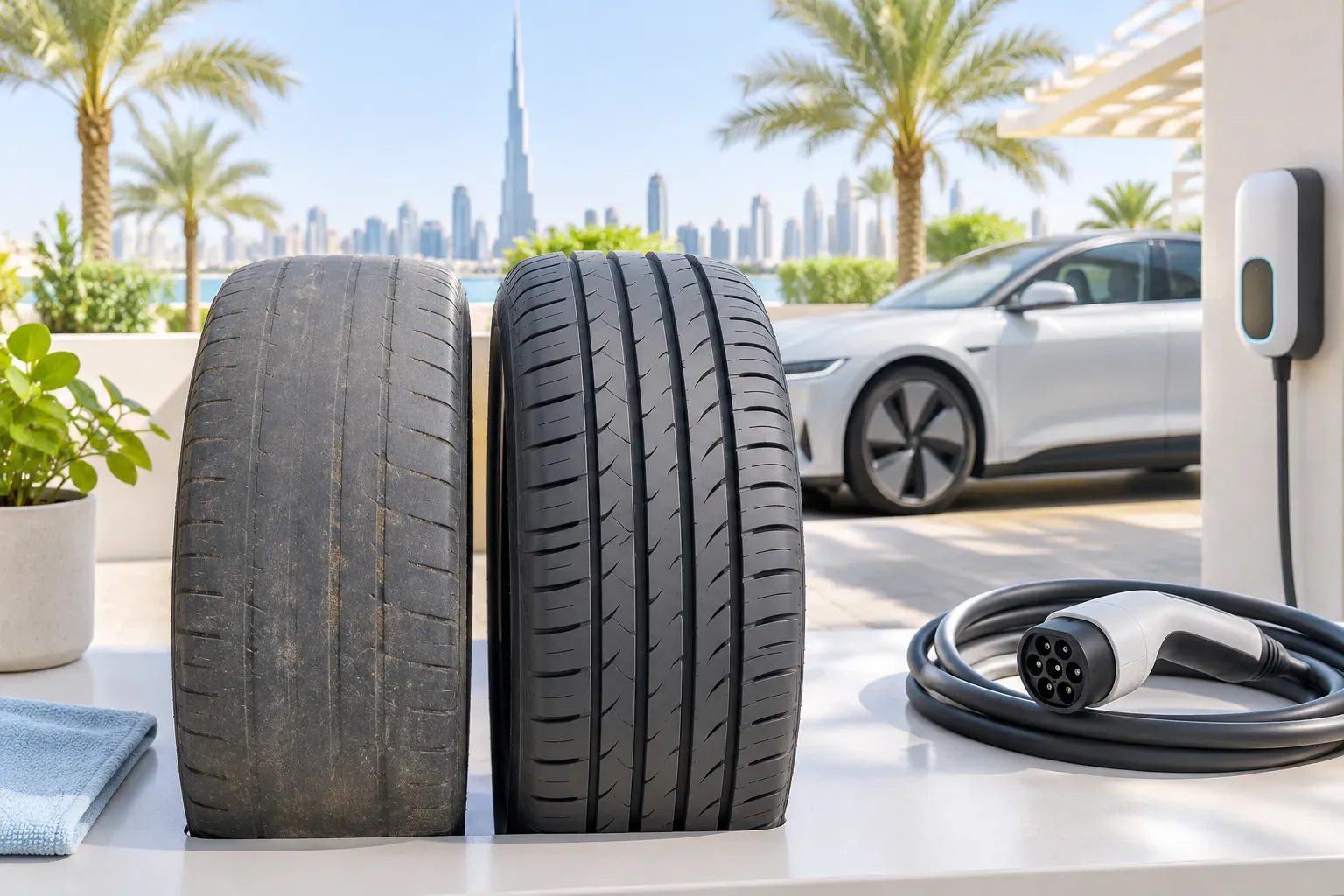
What does EV tyre wear look like?
Reading the wear pattern tells you what to fix:
| What you see | Likely cause | What to do |
|---|---|---|
| Faster wear on the driven axle | Torque and regen | Rotate as your manual allows |
| Both outer edges worn | Low pressure | Correct and monitor pressure |
| Centre of tread worn | Over-inflation | Reduce to the placard figure when cold |
| Inner or outer edge worn | Misalignment | Book a wheel alignment |
| Patchy or scalloped wear | Balance or suspension issue | Balance and inspect the suspension |
| Cracks with good tread depth | Tyre ageing | Check the DOT date |
How can you make EV tyres last longer?
These are the habits that make the biggest difference. None of them requires a change of car or a costly upgrade.
- Keep the correct pressure. Use the figure on your door placard and check when the tyres are cold. EVs are especially sensitive because low pressure hurts both wear and range. See my summer tyre pressure guide.
- Rotate on schedule. Tesla’s own guidance is to rotate every 10,000 km, or sooner if the tread depth difference reaches 1.5 mm. Your own EV’s manual may differ. We offer tyre rotation if you want it done properly.
- Check the alignment. EVs are heavy enough that a small alignment error can eat through an inner edge fast. Book a wheel alignment after a hard kerb strike or when fitting new tyres. My guide on wheel alignment vs balancing explains when you need which.
- Balance the wheels. Vibration creates patchy wear. Wheel balancing is a small job that protects an expensive set.
- Drive smoothly. Roll on the accelerator from standstill, and avoid repeatedly launching at signals. Using a gentler acceleration mode if your car offers one can help.
- Use the right tyre. A tyre with too low a load rating will wear poorly and can be unsafe. Choose from our EV tyres guide.
- Mind the load. Weight is already high, so do not carry unnecessary gear around.
Should you buy a harder tyre to reduce wear?
Harder compounds often last longer, but there is always a trade-off. You may give up some grip or comfort. Performance tyres go the other way, with strong grip and shorter life. For most EV drivers on UAE highways, a road-focused tyre with low rolling resistance is the sensible middle ground. Compare the trade-offs on our tyre performance page.
If you want more acceleration than you need day to day, it may be worth treating that as a choice with a running cost. A set of soft, sticky tyres on a powerful dual-motor car can wear out quickly if the launch button gets frequent use.
When should you replace EV tyres?
Use the same limits as any car. Replace at 1.6 mm of tread, at the wear indicator bars, or when the tyre reaches five years from its manufacture date. Read how long tyres last in the UAE and how to check tyre expiry date for the details.
EV drivers should also measure the inner edge. On low-profile tyres, inner edge wear can hide from view while the outer tread still looks fine. Turn the steering fully and feel or photograph the inside shoulder, or ask a technician to check it during a rotation.
Should you replace EV tyres in pairs?
Replacing in pairs is often the sensible approach, especially on the driven axle. Tesla recommends replacing in pairs unless the other tyres are within 1.5 mm of tread depth. With all-wheel-drive EVs, keeping tread depths close together is important for the drivetrain, so ask before fitting only one or two.
How can you check EV tyre wear at home?
You only need a cheap tread depth gauge and a few minutes. Measure each tyre in three places across the tread: the inner groove, the centre and the outer groove. Write the numbers down or keep them in your phone, along with the date and odometer reading. Repeat every month or two.
Those simple records show you things a quick look cannot. If the inner groove is dropping faster than the outer groove, book an alignment check. If the driven axle is wearing much faster, it may be time to rotate. A steady record also helps you predict when you will need new tyres, so the cost does not catch you by surprise.
Get your EV tyres checked
If your EV is wearing tyres faster than expected, a quick inspection can usually identify why. Our EV tyre service covers inspection, fitting and rotation, and our EV tyres UAE page explains what we can supply. Owners can also browse specific fitment guides for Tesla and BYD, or read the Tesla tyre replacement guide.