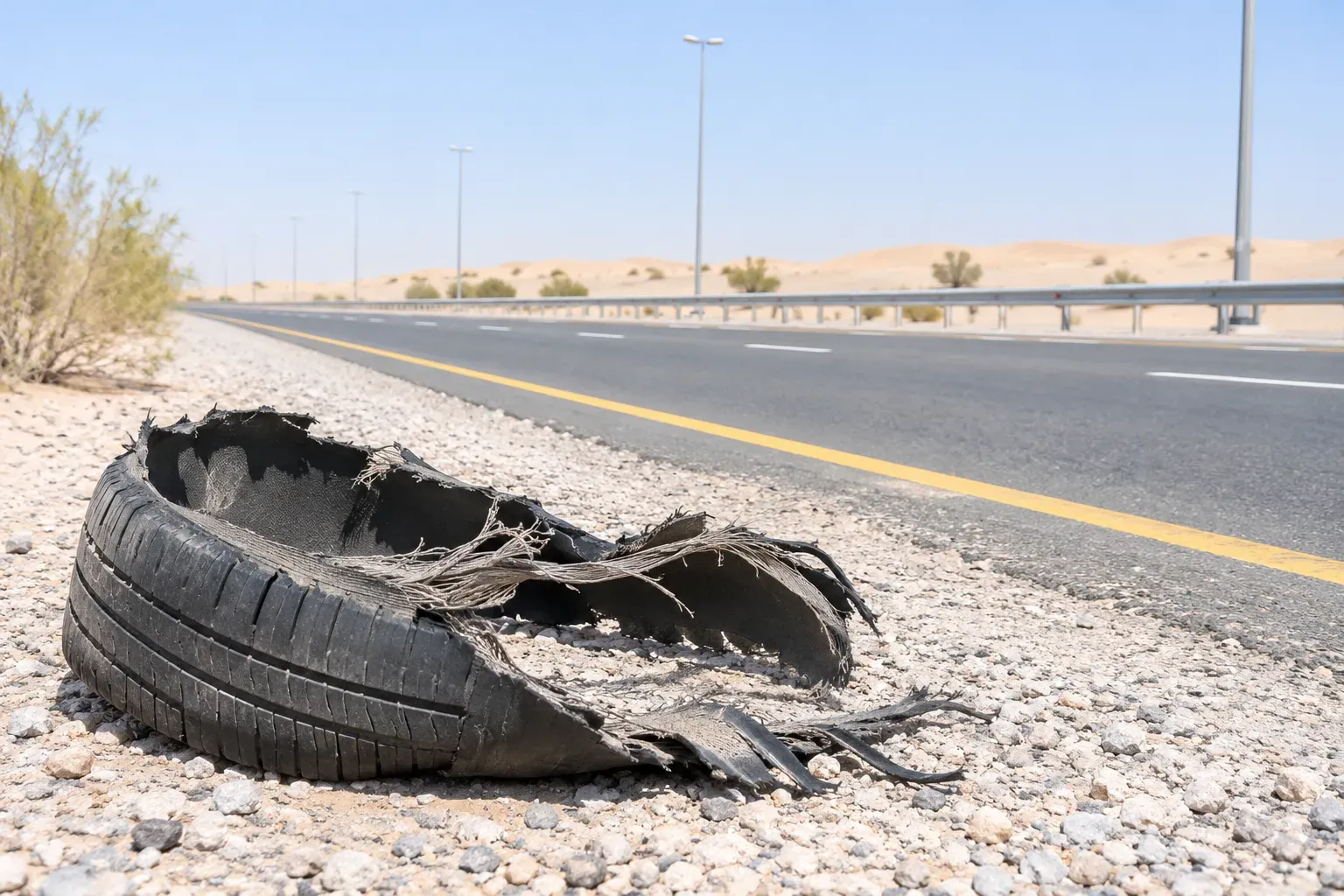
Tyres usually burst in the UAE because of low pressure, old rubber, overloading, impact damage or high speed in extreme heat. These faults weaken the structure until it fails. Prevent it by checking pressure monthly, replacing tyres within five years, avoiding overloads and removing any tyre with a bulge.
Tyres usually burst in the UAE because of low pressure, old rubber, overloading, impact damage or sustained high speed in extreme heat. Each of these weakens the tyre’s structure until it eventually gives way, often on a highway. The good news is that most blowouts have warning signs, and a few simple checks can prevent them.
As a technician, I have looked at many failed tyres. A burst may feel like it came from nowhere, but the tyre itself often tells a longer story. Here is what to look for and what to do if it happens to you.
Why do tyres burst in hot weather?
A tyre is a pressure vessel that flexes with every rotation. That flexing creates heat. On a very hot road at highway speed, the tyre has less ability to shed that heat. A healthy tyre handles it. A tyre that is low on air, aged or damaged can overheat until its layers begin to separate.
UAE authorities take this seriously. Khaleej Times reported that more than 37,900 drivers were fined in 2024 for using vehicles with unsafe or worn tyres, and that driving with unfit tyres carries a Dh500 fine, four black points and a seven-day impoundment. Gulf News has also reported on stepped-up summer inspections.
The main causes of tyre bursts
| Cause | What happens inside | How to prevent it |
|---|---|---|
| Under-inflation | Excess flexing and heat | Check pressure monthly when cold |
| Tyre ageing | Rubber hardens and cracks | Replace within five years |
| Overloading | Tyre runs beyond its capacity | Respect the load index |
| Kerb impact | Internal cords break | Inspect after any hard hit |
| Sidewall bulge | Air pushes through weak structure | Replace at once |
| Old or poor repair | Hidden structural weakness | Use a proper plug and patch |
| Sustained high speed | Heat builds faster | Match speed rating, take breaks |
| Heat cracking | Surface damage spreads | Park in shade, inspect regularly |
Low pressure
This is the cause I would put first. A soft tyre bends more than it was designed to, generating heat throughout the sidewall. It can look almost normal, especially on a low-profile or run-flat tyre, so do not rely on your eyes. My summer tyre pressure guide explains how to check it properly.
Old rubber
Tyres weaken with age even when they are barely used. A car that sits in the sun for months can have tyres with plenty of tread and a badly aged structure. Learn how to check tyre expiry date and read how long tyres last in the UAE.
Overloading
Family trips, heavy luggage and tools all add up. If a vehicle runs above its limit, the tyres carry weight they were never rated for. SUVs, pickups and EV tyres need the correct load rating for this reason. The number is in your tyre size, explained in how to read tyre size.
Impact damage
Hitting a kerb, pothole or speed bump too fast can break the cords inside a tyre. The tyre may keep working for days or weeks before failing later, which is why it can seem so sudden. Low-profile tyres on large rims are especially exposed.
What are the warning signs before a tyre bursts?
Check for these regularly. If you find any, get it looked at before your next long drive:
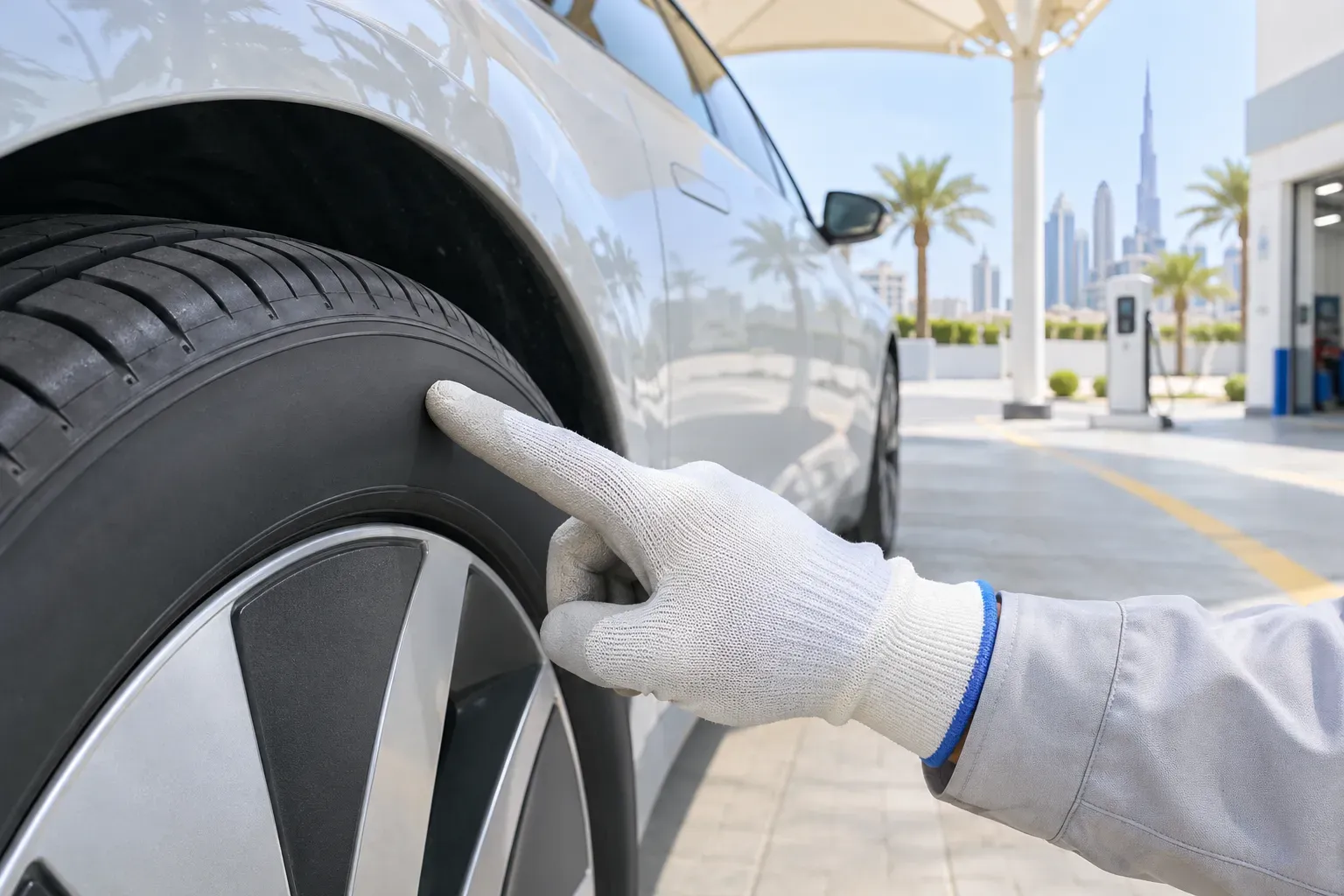
- A bulge or bubble on the sidewall.
- Deep cracks in the sidewall or tread grooves.
- A tyre that keeps losing pressure.
- New vibration in the steering wheel or seat.
- Uneven wear, especially on one edge. See misalignment wear.
- Exposed cords or metal wire.
- Tread that has reached the wear bars.
- A TPMS warning that keeps returning.
If you see a bulge or exposed cords, do not drive on that tyre. Have it changed where the car is, using our flat tyre service or tyre replacement.
What should you do if your tyre bursts while driving?
Your reactions in the first few seconds matter most. Instinct tells you to brake hard, and that is what you should resist.
- Hold the steering wheel firmly with both hands.
- Do not brake hard. Sudden braking can make the car unstable.
- Ease off the accelerator and let the car slow down.
- Keep the car straight and avoid sharp steering.
- Switch on your hazard lights.
- Once the speed has dropped, steer gently toward a safe stopping place.
- Brake lightly only when the car is under control.
- Get yourself clear of traffic. Stand behind a barrier if there is one.
- Call for help. In an emergency or dangerous location, call 999.
Do not try to change a wheel next to fast-moving traffic. Our 24-hour tyre repair in Dubai team can reach you, and it is far safer to wait.
How can you prevent a tyre blowout?
A short routine removes most of the risk:
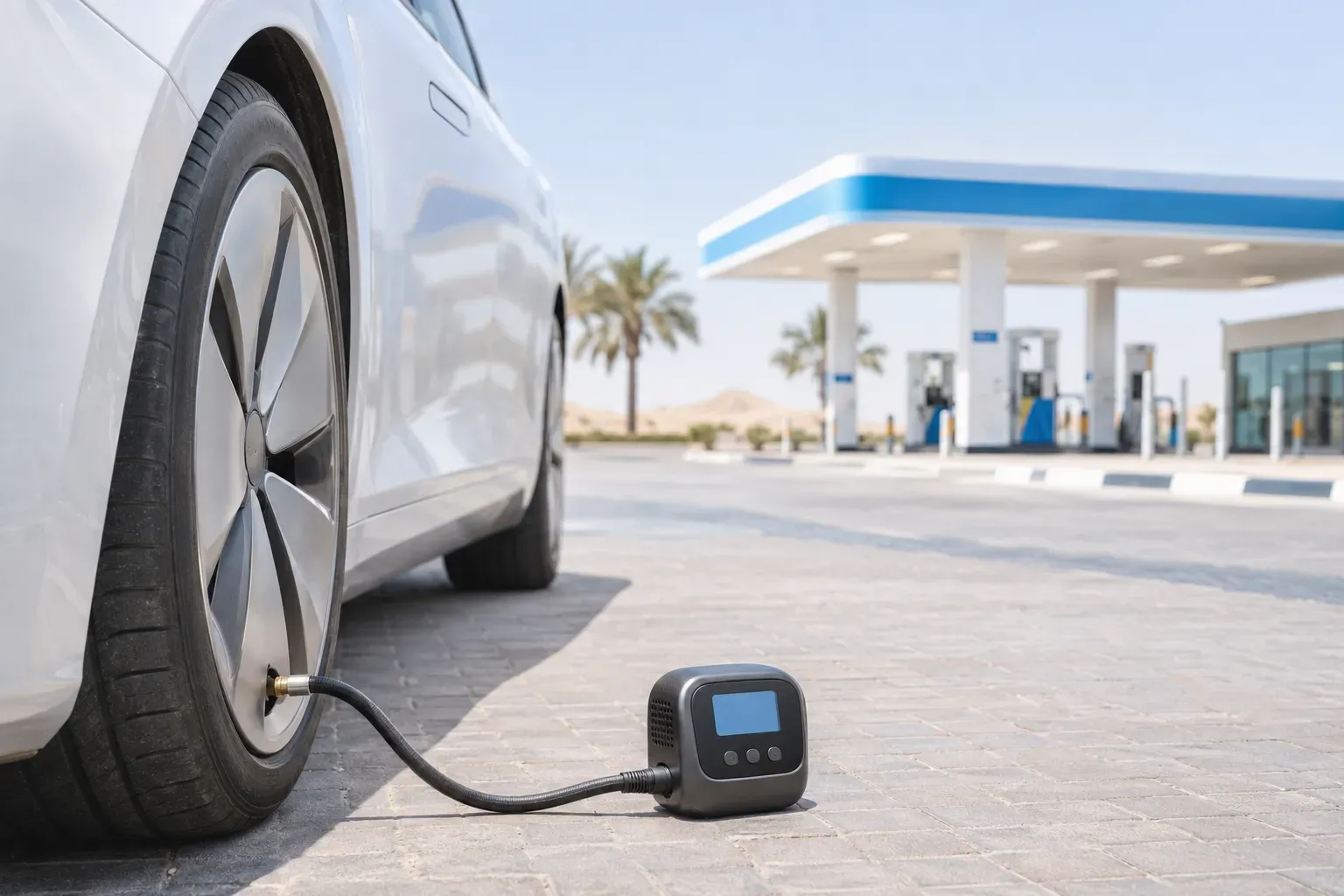
- Check pressure monthly and before long trips.
- Replace tyres within five years of manufacture.
- Inspect all tyres, including the spare.
- Do not exceed your vehicle’s load limit.
- Slow down for speed humps and avoid kerbs.
- Have tyres inspected after a hard impact.
- Use proper repairs. Read can a punctured tyre be repaired.
- Keep up with wheel alignment and balancing.
- Choose a tyre with the right rating, as explained in best tyres for UAE heat.
See our tyre care guide for more on keeping them in good condition.
Are EVs more at risk?
EVs are not inherently more likely to burst, but they are heavy, so their tyres work harder. A low-pressure tyre with the wrong load rating is a bigger concern on a two-tonne electric SUV. Read do EVs need special tyres to make sure yours are correctly rated.
Can a new tyre burst?
Yes, although it is uncommon when the tyre is correctly fitted and looked after. A new tyre can still be damaged by a hard kerb strike, run at low pressure or overloaded. Poor fitting can also damage the bead, which is the part of the tyre that seals against the rim.
That is why I recommend having a new set checked after the first few days of driving. Confirm the pressure, look for any bulges and make sure the car feels steady. If you notice vibration or a sudden pressure drop, have it inspected straight away. A new tyre does not excuse you from the same basic checks as an older one.
Do not wait for a warning at 120 km/h
If your tyres are old, damaged or you simply have not checked them for a while, have them inspected before your next highway trip. You can visit our tyre shop in Dubai, ask for mobile tyre repair, or reach us from Abu Dhabi and Sharjah. If a replacement is due, our new tyres page is the next step.