Run-flat tyres let you keep driving after a puncture, typically up to 80 km at up to 80 km/h, while normal tyres need immediate attention. Normal tyres are usually more comfortable and cheaper. If your car came with run-flats and has no spare, keep them unless you have a clear puncture plan.
Run-flat tyres let you keep driving after a puncture, typically for up to 80 km at up to 80 km/h. Normal tyres cannot do that, but they usually ride more comfortably, cost less and are easier to repair. If your car came with run-flats and has no spare wheel, I generally suggest staying with run-flats unless you have a clear plan for dealing with a puncture.
BMW, Mercedes and other premium cars in the UAE often arrive on run-flats, and their owners regularly ask me if they can switch. The answer depends on your car, your routes and what you value most.
What is a run-flat tyre?
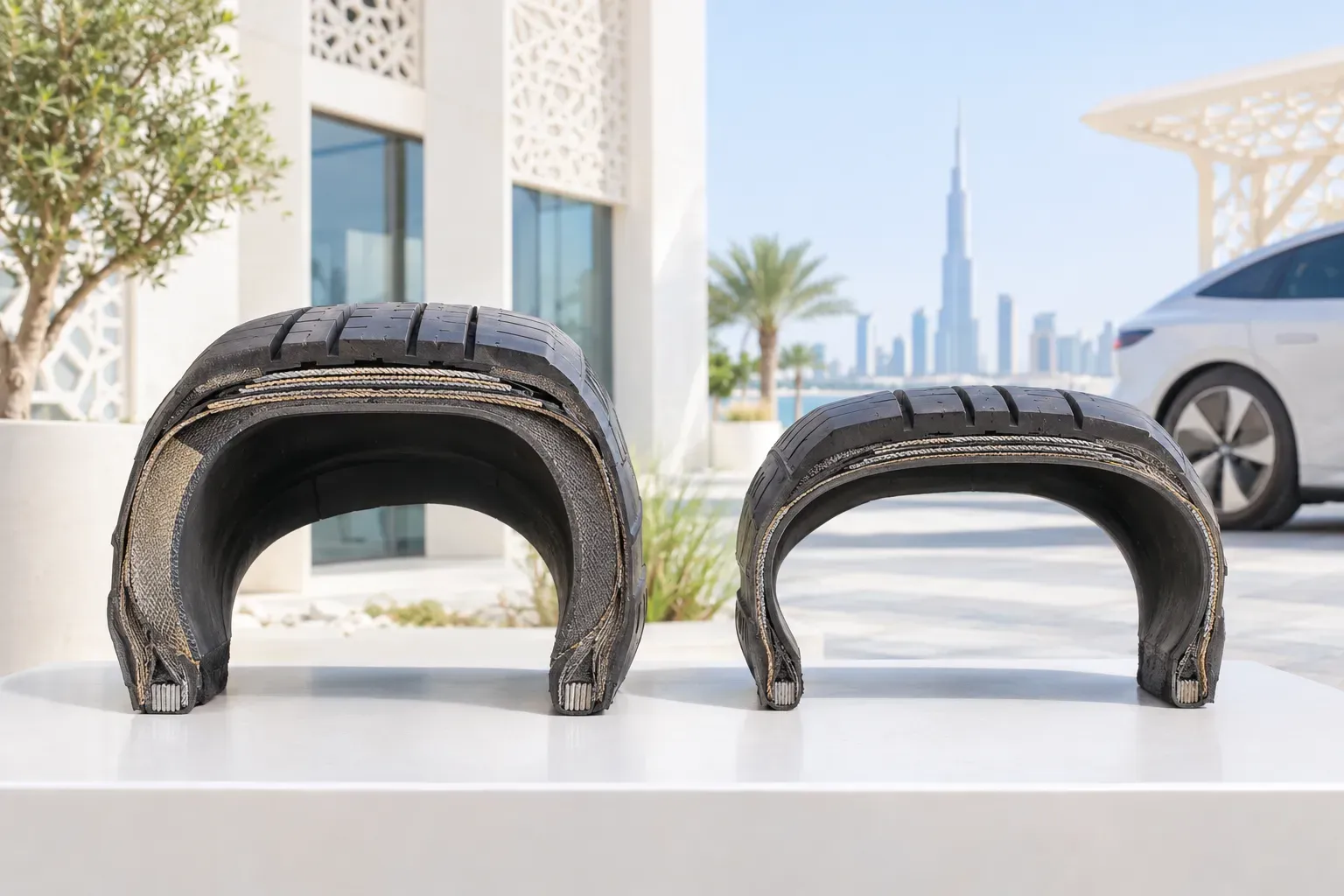
A run-flat tyre has a thick, reinforced sidewall strong enough to hold the car up for a limited distance when the air is gone. A normal tyre relies on the air pressure to keep its shape, so it collapses quickly when that pressure drops.
According to Michelin, the stiff sidewall keeps the tyre’s shape, allowing you to drive at reduced speed, typically up to 80 km/h, for a limited distance, usually up to 80 km. Always follow the limits given by your own tyre and vehicle manufacturer. Run-flat tyres need a working pressure monitoring system, because you may not feel the puncture at all.
Run flat vs normal tyres at a glance
| Factor | Run-flat tyre | Normal tyre |
|---|---|---|
| After a puncture | Drive on at reduced speed | Stop as soon as it is safe |
| Spare wheel | Often not carried | Usually needed, or a kit |
| Ride comfort | Firmer | Usually softer |
| Road noise | Can be higher | Often lower |
| Weight | Heavier | Lighter |
| Price | Usually higher | Usually lower |
| Repairability | More restricted | Easier within limits |
| TPMS | Essential | Recommended |
| Availability | Fewer sizes and patterns | Wide choice |
What are the advantages of run-flat tyres?
You can get out of a dangerous place
This is the main benefit in the UAE. Stopping on the hard shoulder of a fast highway is genuinely risky. A run-flat lets you carry on to the next exit or a safe parking area, which is much better than changing a wheel next to fast traffic.
You may not need a spare
Skipping the spare frees up boot space and saves weight. For many premium cars, that is why they were designed this way.
Better control during sudden deflation
Because the sidewall holds its shape, the car tends to stay more stable when pressure is lost. This does not make a blowout harmless, but it can give you more control. If you want to know what causes those failures, read why tyres burst in the UAE.
What are the disadvantages?
Stiffer sidewalls usually mean a firmer ride, and you notice it on speed humps and rough patches. The tyres typically cost more, and you will find fewer sizes and patterns in stock. Our car tyre cost page gives starting prices, and how much tyres cost in the UAE explains what else moves the number.
The other big issue is repairability. After a run-flat has been driven without air, it may have internal damage you cannot see from outside. That is why a technician needs to take it off the rim and inspect it.
Can I replace run-flat tyres with normal tyres?
Sometimes, but do not treat it as a simple swap. Before you change, go through these checks:
- Read your owner’s manual. Some manufacturers advise against switching.
- Plan for punctures. You will need a spare tyre, a repair kit or a reliable roadside option like our flat tyre service.
- Match the size, load and speed ratings. Never go below the specification. See how to read tyre size.
- Consider the suspension setup. Cars designed around run-flats may feel different on softer tyres.
- Change at least a full axle, and preferably all four. Avoid mixing run-flats and normal tyres on the same axle.
- Keep your TPMS working. It is still valuable, and a TPMS service can fix faulty sensors.
If you do most of your driving in the city with help close by, a switch can improve comfort. If you regularly take long desert or inter-emirate trips, staying with run-flats may be the safer call.
Can run-flat tyres be repaired?
Sometimes. It depends on where the damage is and how the tyre was used after the puncture. Michelin says repair may be possible if the injury is within the repairable zone and the tyre has not been operated below the minimum pressure for an extended time. Some manufacturers are stricter. The general rules are in my guide on whether a punctured tyre can be repaired, and our puncture repair service can assess it.
Are run-flats a good idea in UAE heat?
They can work well, but there is one thing I want drivers to take seriously. A run-flat driven without air generates a lot of heat in its sidewall. On a very hot road, that heat builds faster, so do not stretch the distance or speed limits. When the warning comes on, slow down and head straight for help.
The same pressure discipline applies as with any tyre. Under-inflation on a stiff sidewall can be hard to spot by eye, so use a gauge, not your judgement. My summer tyre pressure guide explains how to measure properly.
What about EVs?
Most EVs do not use run-flats as standard, partly because of weight and efficiency concerns. Many carry a sealant kit instead. If you drive an EV, the priority is a tyre with the correct load capacity, as explained in do EVs need special tyres. See also our EV tyres guide.
How do you know if your car has run-flat tyres?
Look at the tyre sidewall for a marking such as RFT, ROF, ZP, SSR or a run-flat symbol, because brands use different codes. You can also check the boot. If there is no spare wheel and no sealant kit, the car may have been supplied on run-flats. Your owner’s manual will confirm what the manufacturer specified.
Do this before you have a puncture. Previous owners sometimes change to normal tyres without adding a spare, which leaves the car with no backup at all. If that is your situation, either buy a suitable repair kit or keep a roadside service number saved in your phone.
Which should you choose?
Choose run-flats if your car was designed for them, has no spare, or you often drive long empty stretches. Choose normal tyres if comfort and cost are your priority, your manual allows it, and you have a reliable way to handle a puncture.
If you drive a BMW or Mercedes, check our brand pages for typical fitments. To discuss your car, send your details through our tyre shop in Dubai page, or arrange tyre replacement at a time that suits you in Dubai, Abu Dhabi or Sharjah.